 1199163600
Public Domain
Public Domain is a copyright term that is often used when talking about copyright for creative works. Under U.S. copyright law, individual items that are in the public domain are items that are no longer protected by copyright law. This means that you do not need to request permission to re-use, re-publish or even change a copy of the item. Items enter the public domain under U.S. copyright law for a number of reasons: the original copyright may have expired; the item was created by the U.S. Federal Government or other governmental entity that views the things it creates as in the public domain; the work was never protected by copyright for some other reason related to how it was produced (for example, it was a speech that wasn't written down or recorded); or the work doesn't have enough originality to make it eligible for copyright protection.
Citation
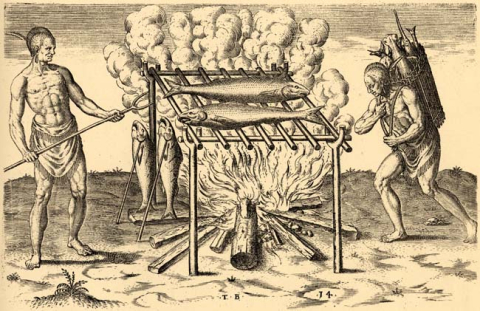
de Bry, Theodor. "The brovvyllinge of their fishe ouer the flame". In A Briefe and True Report of the New Found Land of Virginia: of the Commodities and of the Nature and Manners of the Naturall Inhabitants : Discoered bÿ the English Colonÿ There Seated by Sir Richard Greinuile Knight In the ÿeere 1585 : Which Remained Vnder the Gouerenment of Twelue Monethes, At the Speciall Charge and Direction of the Honourable Sir Walter Raleigh Knight Lord Warden of the Stanneries Who therein Hath Beene Fauoured and Authorised bÿ Her Maiestie and Her Letters Patents / This Fore Booke Is Made in English by Thomas Hariot seruant to the Aboue-Named Sir Walter, a Member of the Colonÿ, and There Imploÿed in Discouering, by Thomas Hariot. Richard Hakluyt and Theodor de Bry, 1590. Illustration. Documenting the American South, University Library, University of North Carolina at Chapel Hill. Accessed February 20, 2026.